Can Killer Whales Really Kill a Whale Shark? Inside a Brand-New Scientific Discovery
Picture the largest fish in the ocean — longer than a city bus, patterned with pale spots like a starlit night, drifting calmly through open water with its mouth open, filtering plankton. The whale shark has no reason to expect trouble. It has no real predators. Nothing hunts something that size.
Except, it turns out, something does.
In 2022 and again in 2023, researchers working with tour operators in Panama and Ecuador documented something that had never been formally recorded in those waters before: killer whales deliberately hunting, attacking, and killing whale sharks. And one of the whales involved would later turn up somewhere unexpected — inside the Galápagos Marine Reserve.
The gentle giant
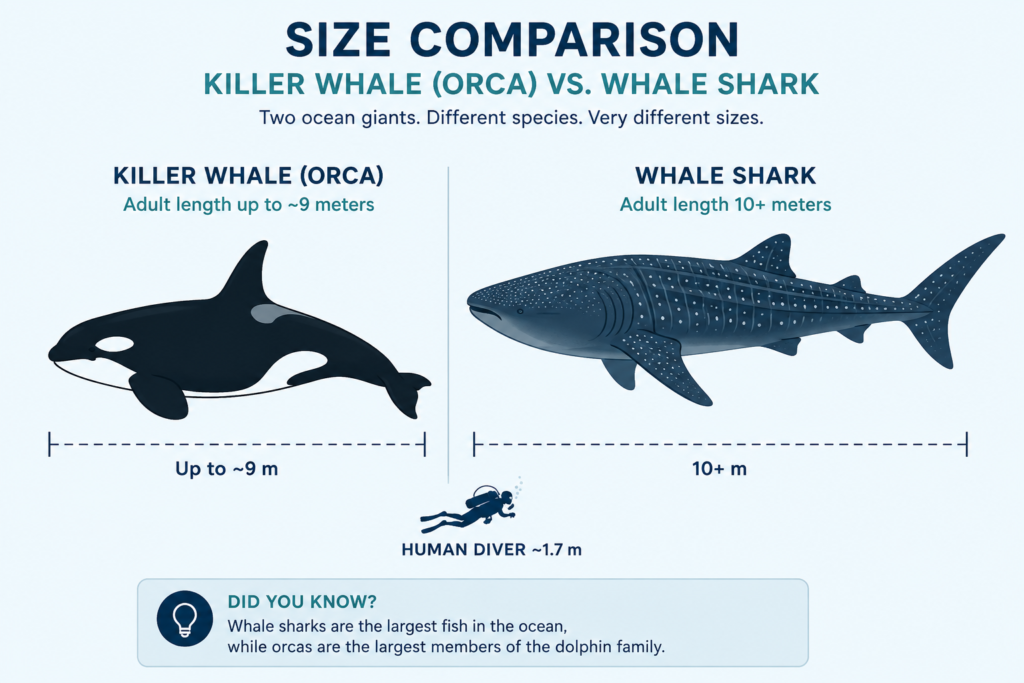
Whale sharks (Rhincodon typus) are filter feeders, built for scale rather than speed. An adult can grow well beyond 10 meters (33 feet), yet feeds almost entirely on plankton and small fish, filtered from the water as it swims with its mouth open. They are, by almost any measure, among the least aggressive large animals in the ocean — and until recently, documented predation on a fully wild whale shark was exceptionally rare anywhere in the world.
That rarity is part of what makes these new observations so significant.
Two attacks, two countries
The first event took place on July 12, 2022, near Isla Coiba, Panama. During a tourist outing, a pair of killer whales was seen interacting with a juvenile whale shark roughly 6 to 8 meters long, about 10 kilometers offshore. Over 25 to 30 minutes, the two orcas took turns pressing against the shark’s body, mostly at the surface, while the shark repeatedly tried to duck beneath the tour boat — seemingly attempting to escape. By the end of the encounter, blood was visible in the water.
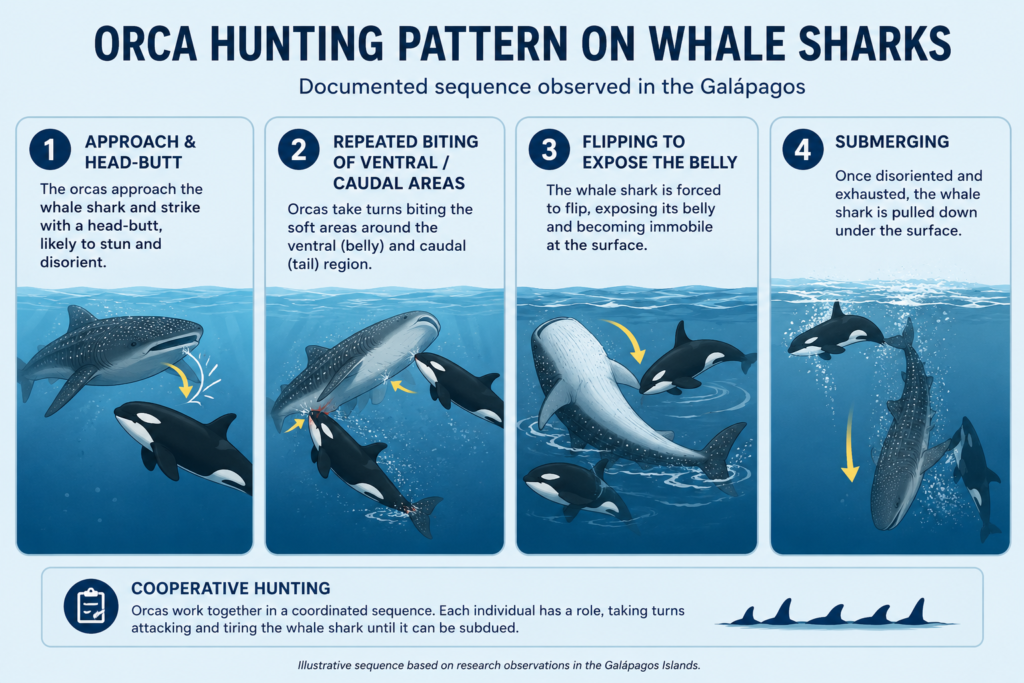
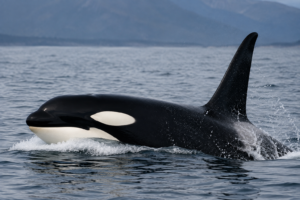
The second event happened on December 8, 2023, off Machalilla National Park on Ecuador’s mainland coast. This time, a group of four killer whales — a young individual, two females, and a male — surrounded a juvenile whale shark of similar size. Researchers aboard a tour vessel followed the encounter for roughly two kilometers and 30 minutes, watching the orcas deliver repeated bites to the shark’s underside and tail before eventually flipping it over, exposing its vulnerable belly.
These were the first formally published records of killer whales preying on whale sharks anywhere along the coastal waters of Ecuador and Panama.
How do you take down an animal the size of a school bus?
Across both events, the killer whales followed a strikingly similar playbook. They targeted the whale shark’s underside and tail rather than attempting a single decisive strike, repeatedly head-butting and biting those areas over many minutes rather than seconds. At a certain point in each encounter, the orcas maneuvered the shark so its belly faced upward — a position that appears to leave it far more vulnerable — before continuing to bite.
This methodical, coordinated approach — patient rather than explosive — echoes a broader pattern seen elsewhere in the killer whale’s hunting repertoire: rather than relying on raw speed or a single overwhelming strike, orcas often use teamwork and sustained pressure to wear down prey many times their own body’s surface area, even when, as with a whale shark, that prey is technically larger than any individual whale involved.
Not an isolated incident
These weren’t the only recent whale shark attacks recorded in the region. Since 2018, researchers in the Gulf of California, Mexico, have documented four separate instances of killer whale predation on whale sharks over a six-year period, largely involving the same repeat-offending individual and his group. Together with the new Panama and Ecuador records, a pattern is emerging across the wider Eastern Tropical Pacific — not a single freak encounter, but a hunting behavior that appears to recur, in different locations, among different individuals, more than two decades after the very first documented case of this kind of predation in the region.
The Galápagos connection
Here is where the story becomes personal — and where it connects directly to the Galápagos.
Researchers compared photographs of the killer whales involved in the Ecuador attack against the long-running Galápagos killer whale photo-identification catalogue, the same one built from decades of naturalist-guide photographs. One of the four whales — an adult male from the Ecuador pod — matched an individual later re-sighted on May 30, 2024, near northern Wolf Island, well inside the Galápagos National Park.
That resighting was reported opportunistically, by a group of tourists who noticed the same four killer whales traveling alongside numerous frigatebirds — often a sign of feeding activity nearby, though the observers weren’t able to confirm what, if anything, the whales were eating that day.
It’s a small but powerful piece of evidence: an individual whale, photographed attacking a whale shark off the coast of mainland Ecuador, later recognized nearly a year afterward inside Galápagos waters. Darwin and Wolf Islands, in the far north of the archipelago, are themselves well known as a gathering site for adult whale sharks — though, intriguingly, no confirmed predation event has yet been documented there, aside from a single secondhand account from a local fisherman.
Why orcas here eat almost anything
It helps to understand that not all killer whales eat the same way. In colder, more predictable waters like the Pacific Northwest, distinct populations specialize tightly — some eat almost nothing but salmon, others almost nothing but marine mammals. In the tropical Eastern Pacific, including Galápagos, killer whales behave more like generalists, feeding opportunistically on fish, sharks, sea turtles, sea lions, and even other whales, depending on what the ocean offers.
A whale shark, in that light, isn’t an anomaly — it’s one more entry on an already remarkably varied menu, alongside previously documented Galápagos attacks on Bryde’s whales and sperm whales. It’s a reminder that the label “apex predator” doesn’t mean picky; in these waters, it seems to mean opportunistic.
A global effort, built on tourist photographs
This discovery didn’t come from a dedicated research expedition chasing a specific hypothesis. It came from tour guides and travelers who happened to have a camera ready.
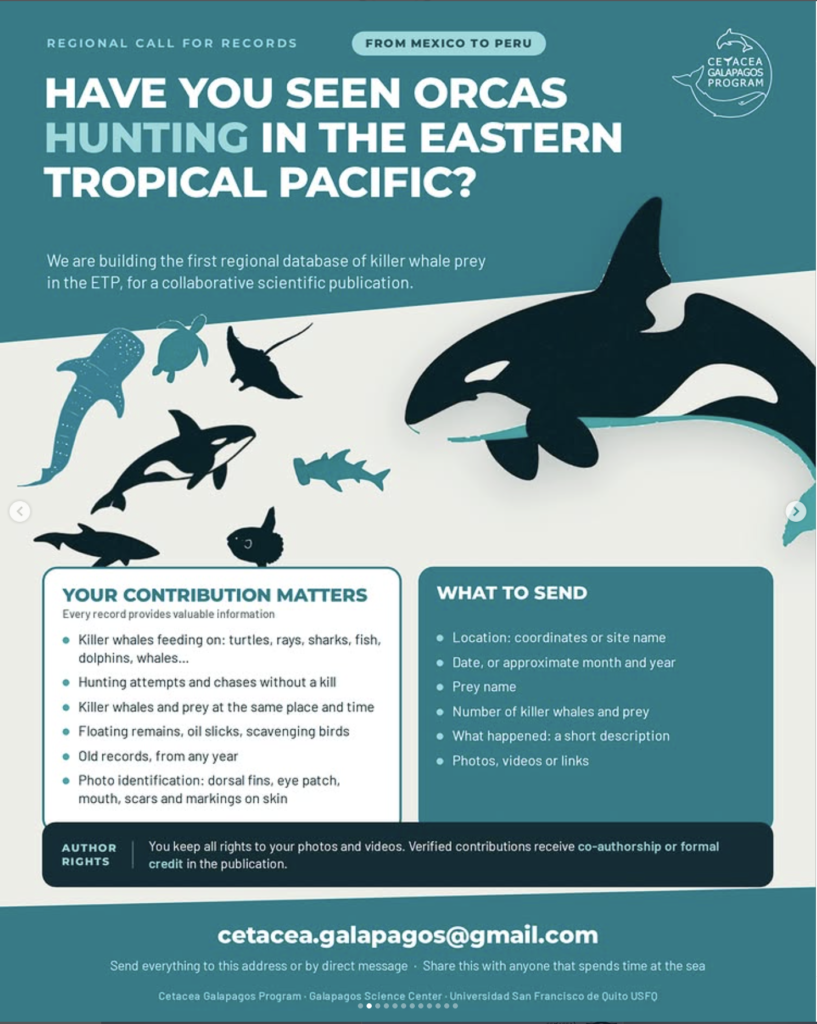
Both the Panama and Ecuador sightings were documented by naturalist guides and researchers working directly with tourist vessels — one recorded with a GoPro submerged just meters from the animals. And these two events now form part of something larger: a newly published, first-of-its-kind global image repository cataloguing interactions between killer whales and sharks and rays worldwide. Built from 320 photographs and videos representing 82 separate encounters across 12 countries, it draws on contributions from research teams and tourism operators — including outreach specifically to companies working in the Galápagos Islands.
It’s a clear demonstration of a pattern that runs through nearly all of this region’s cetacean research: the people best positioned to witness rare, dramatic moments of ocean life are very often not scientists with grant funding, but guides and travelers already out on the water for entirely different reasons.
What scientists still don’t know
For all the drama of these encounters, plenty remains genuinely unresolved. Researchers don’t yet know whether this hunting behavior is a shared, learned strategy passed between different killer whale groups across the Eastern Tropical Pacific, or whether separate groups have independently arrived at similar techniques. The individuals photographed attacking whale sharks in Panama and Mexico don’t match any individuals in the existing Galápagos catalogue, suggesting the picture is more complicated than a single population repeating a single trick.
It’s also not known how often this happens, how much of a whale shark’s population is affected, or why — despite Darwin and Wolf Islands hosting some of the densest known whale shark aggregations anywhere on Earth — no confirmed predation event has yet been recorded there. Every one of these open questions depends on the same resource that produced the discovery in the first place: more photographs, from more encounters, compared against a growing regional catalogue.
Why this discovery matters
Whale sharks are listed as Endangered on the IUCN Red List, making every detail of their biology — including what, if anything, preys on them — directly relevant to their conservation. Understanding predator-prey relationships between two of the ocean’s most iconic animals helps researchers build a more complete picture of how the Eastern Tropical Pacific’s food web actually functions, rather than relying on assumptions carried over from better-studied, colder-water ecosystems.
It’s also a genuinely rare thing in marine science: a discovery this significant, published this recently, with a direct and individually verified thread back to the Galápagos Islands.

Frequently Asked Questions
Do killer whales actually eat whale sharks? Yes. Documented predation events in the Gulf of California (Mexico, since 2018), and newly published records from Panama (2022) and Ecuador (2023), confirm killer whales attacking, killing, and in at least some cases consuming whale sharks.
How big is a whale shark compared to a killer whale? Whale sharks can exceed 10 meters (33 feet) in length, making them larger than even the biggest adult male killer whales, which reach roughly 9 meters (about 30 feet). The whale shark is the largest fish on Earth.
How do killer whales kill something so much larger than themselves? By working together and targeting specific vulnerable areas — repeatedly biting the shark’s ventral and tail regions, and eventually flipping it to expose its underside — rather than relying on size or a single strike.
Where has this behavior been documented? Confirmed events have been recorded in the Gulf of California, Mexico; near Isla Coiba, Panama; and off Machalilla National Park on Ecuador’s mainland coast. No predation event has yet been confirmed within the Galápagos Islands themselves.
Is this the same as orcas hunting Bryde’s whales or sperm whales in Galápagos? It’s part of the same broader pattern — Galápagos-region killer whales are documented, opportunistic feeders on an unusually wide range of large prey, from baleen whales to sharks.
Has whale shark predation been confirmed in the Galápagos itself? Not yet directly observed, despite Darwin and Wolf Islands being one of the world’s best-known whale shark aggregation sites — a genuine open question in current research.
What is the “Galápagos connection” in this discovery? One of the four killer whales photographed during the December 2023 Ecuador attack was later re-sighted inside Galápagos National Park waters near Wolf Island in May 2024, confirmed through photo-identification matching.
Are whale sharks endangered? Yes. Whale sharks are listed as Endangered on the IUCN Red List, which makes understanding every aspect of their biology, including predation, directly relevant to their conservation.
Is this predation harming whale shark populations? It isn’t currently known how frequently this occurs or what effect, if any, it has at the population level — this is one of several open questions researchers are working to answer.
How do scientists identify individual killer whales across countries? By comparing photographs of natural markings — dorsal fin shape and nicks, saddle patch pattern, and eye patch — against regional photo-identification catalogues, the same method used throughout Galápagos killer whale research.
Can travelers help with this kind of research? Yes. Both of these newly published attacks were documented by naturalist guides and travelers aboard tourist vessels, and a broader global research effort now actively collects this kind of imagery from tour operators worldwide.
Are killer whales dangerous to snorkelers or divers near whale sharks? There are no documented attacks on humans by wild killer whales anywhere in the world. Their predatory behavior toward other marine species is not known to extend to people.