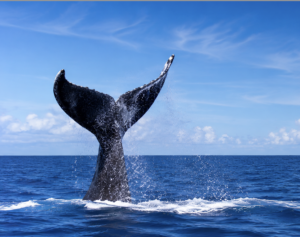
GALAPAGOS BLUE WHALES

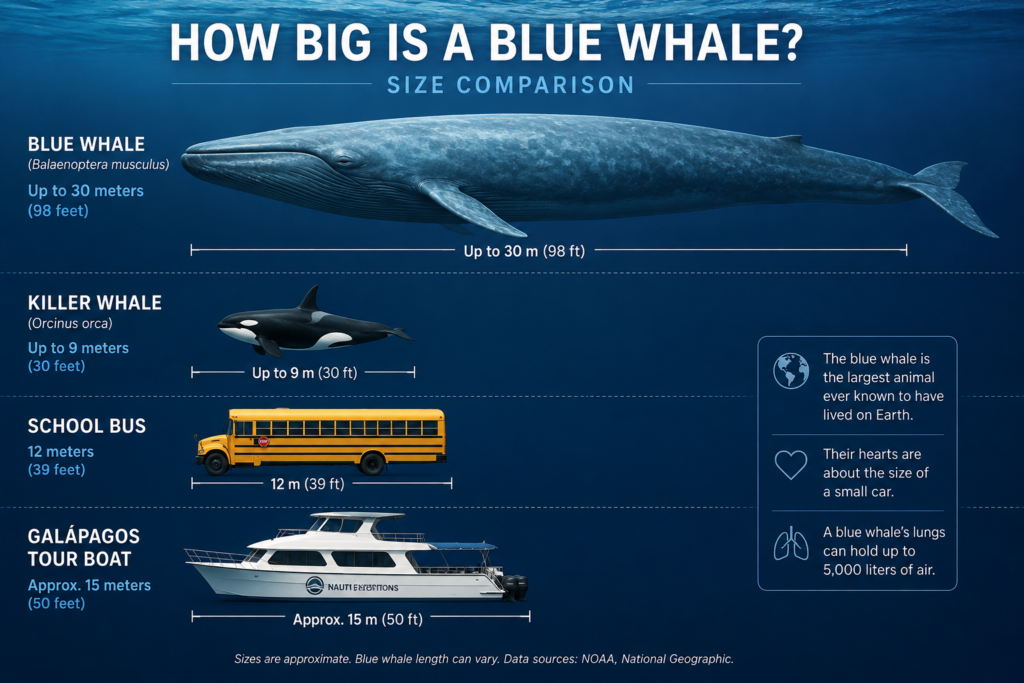
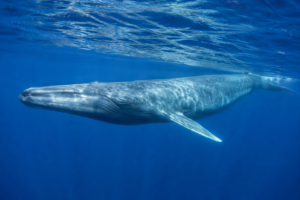
The blue whale is the largest animal known to have ever existed on Earth — larger than any dinosaur, its heart alone roughly the size of a small car. And yet, for most of the last century, almost nothing was known about whether this giant ever visited the waters around the Galápagos Islands, or where it went when it did.

That changed with a single whale, photographed three times over seven years, in two different countries, on opposite sides of the equator. Its story became the first real evidence that blue whales from the Northern and Southern Hemispheres — populations long assumed to stay largely apart — might actually be meeting, right here, in Galápagos waters.

A rare visitor or a hidden resident?

Blue whales were hunted to the edge of extinction during the twentieth century, before international protections took effect in 1966. Some populations have never recovered: Antarctic blue whales remain at less than 1% of their pre-whaling numbers, while the Southeast Pacific population — the one most closely tied to Galápagos — is estimated at only around 7.5% of historical levels.

Unlike Galápagos regulars such as Bryde’s whales or bottlenose dolphins, blue whales are true rarities here. Between 1978 and 1995, researchers recorded only 55 individual blue whales across an entire 17-year survey period. For a long time, that scarcity made it difficult to say much with confidence about how — or even whether — this population connects to blue whales anywhere else in the ocean.

Seventeen years, one photograph at a time

Starting in 2001, researchers began systematically compiling opportunistic sightings of blue whales in Galápagos waters, largely gathered by trained naturalist guides aboard tour vessels following their regular routes. Over the following 17 years, through 2018, this effort logged 65 separate blue whale sightings — nearly three times the number recorded in the earlier 1978–1995 survey period, a change that may reflect a genuinely recovering population, increased observation effort, or some combination of both.

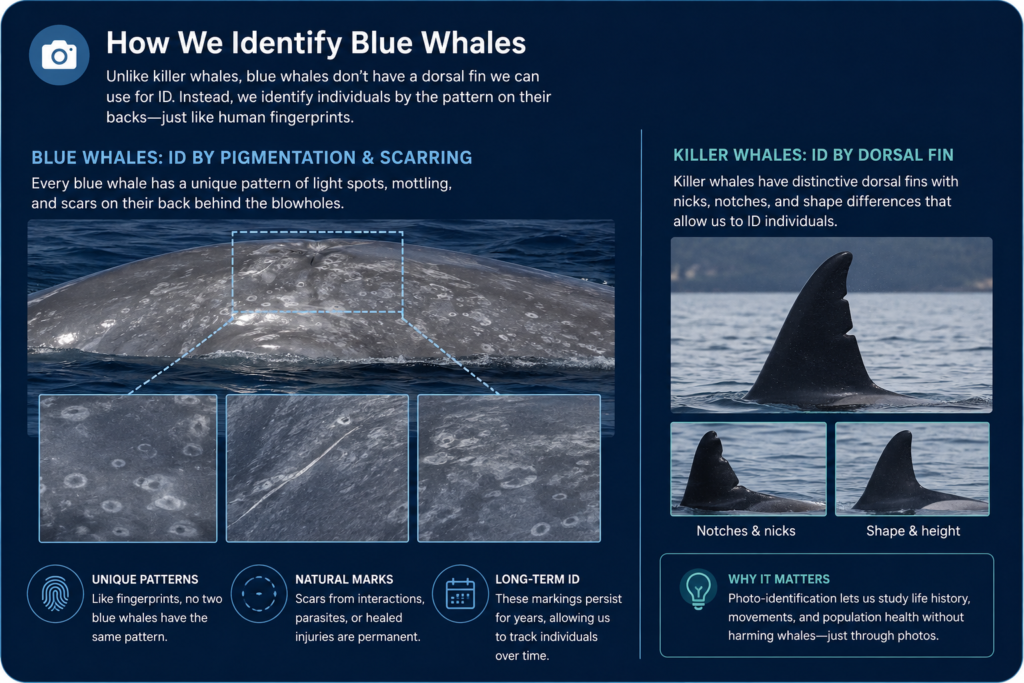
Blue whales, like killer whales, can be recognized as individuals — not by a dorsal fin’s shape alone, since a blue whale’s fin is small and unremarkable, but by the mottled pigmentation pattern on its back near the fin, along with any scars or nicks unique to that animal. By 2018, researchers had used this method to identify 13 individual blue whales in Galápagos waters.

Most sightings involved lone animals or pairs; roughly half of all sightings were singletons, and just over a quarter were pairs. But occasionally, something extraordinary appeared: in September 2016, a single group of 30 or more blue whales was spotted off Punta Vicente Roca, on the northern tip of Isabela Island — an almost unimaginable gathering of the largest animal on Earth in one place.

The whale that rewrote the map

Of the 13 identified individuals, one — catalogued as BWGal008 — became the key to a much bigger discovery.

BWGal008 was first photographed on February 17, 2009, at Caleta Iguana, off the southern coast of Isabela Island, moving in slow, irregular circles through the bay for at least 90 minutes. The whale was seen again the following afternoon, then not documented again for nearly five years.

On January 15, 2014, a whale matching the same pigmentation pattern and scarring was photographed roughly 600 nautical miles away, at the Costa Rica Dome — a separate, distant upwelling zone off Central America known as an important feeding and possible wintering area for blue whales, particularly those associated with the Northern Hemisphere population.

Then, on May 16, 2016, the same individual reappeared in Galápagos waters, this time off the northern coast of San Cristóbal Island, traveling alongside a second identified whale. Three independent international blue whale experts — reviewing the photographs separately — confirmed the match across all three sightings.

One whale. Three sightings. Two countries. Seven years.

What that journey reveals

To understand why this single whale’s movements matter so much, it helps to know that blue whales in the Eastern Pacific aren’t thought to be one uniform population. Genetic research has identified distinct Northern and Southern Hemisphere blue whale subspecies using these waters — the Northern group associated more closely with the Costa Rica Dome and Baja California, the Southern group breeding along the coasts of Peru and Ecuador, including the Galápagos Islands.

Until BWGal008’s photographs were compared, the Galápagos was generally treated as a breeding ground belonging to the Southern Hemisphere stock. But this individual’s back-and-forth movement between Galápagos and the Costa Rica Dome — combined with the fact that 18% of all Galápagos blue whale sightings occurred during the austral summer, when Northern Hemisphere whales could plausibly be present — suggests something more interesting: that the Galápagos may function as a genuine geographic and seasonal crossroads, where whales from both hemispheres’ populations overlap in time and space.

It’s a small piece of evidence, drawn from a single animal. But in a population this poorly studied, a single well-documented individual can meaningfully shift the scientific picture.

Why come here at all?

For decades, it was assumed blue whales passing through the tropical Eastern Pacific were essentially just transiting — using the region as a corridor rather than a place to actually feed, since most of the world’s known blue whale feeding grounds are in cold, high-latitude waters rich in krill.

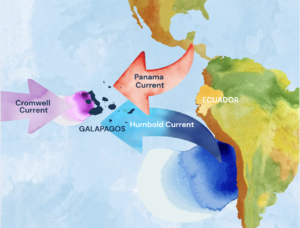
More recent observations complicate that assumption. Researchers have directly observed Galápagos blue whales feeding — rolling on their sides at the surface with mouths open, a clear feeding posture — in 9 of 20 documented sightings during the cold season alone. This lines up with what makes the Galápagos so unusual in the first place: the Cromwell Current, also known as the Equatorial Undercurrent, rises to the surface here and fuels one of the most productive upwelling systems in the tropical ocean, complete with the small crustaceans (euphausiids) blue whales rely on elsewhere in the world.

Most sightings cluster in the Bolívar Channel, between Isabela and Fernandina, and along the northern coast of Isabela — precisely the region most strongly shaped by that upwelling. It’s a reminder that “tropical” and “unproductive” aren’t the same thing, and that the same ocean engine drawing killer whales, sea lions, and dense schools of fish to these waters may be feeding the largest animal on the planet as well.


A population still living in whaling’s shadow

None of this happens in a vacuum. Every blue whale alive today is a descendant of the small fraction that survived one of the most intensive hunts in human history. The Southeast Pacific population most closely tied to Galápagos remains at a small fraction of its historical size, and recovery — where it’s happening at all — is slow, generational, and still poorly measured in these particular waters.

That’s part of what makes each individually identified whale valuable. In a population this small and this rarely observed, a single confirmed sighting adds real information; a single confirmed hemisphere-crossing individual adds a genuinely new hypothesis to the field.

What scientists still don’t know

The overlap suggested by BWGal008’s movements is a hypothesis, not a settled fact. Researchers are clear that genetic sampling — comparing DNA from Galápagos-sighted whales against known Northern and Southern Hemisphere populations — is still needed to confirm whether interbreeding between the two subspecies actually occurs here, and if so, how often.

It also isn’t yet known how many blue whales use Galápagos waters in total, how site-faithful individuals are over their full lifetimes, or exactly what draws some whales to linger here for weeks while others simply pass through. Every one of these questions depends on the same slow, patient method that produced this discovery in the first place: more photographs, gathered over more years, compared against catalogues on both sides of the equator.

Why this discovery matters

Blue whales are listed as Endangered on the IUCN Red List, and effective conservation for a migratory species depends entirely on understanding where it goes and why. If the Galápagos genuinely functions as a shared habitat for two distinct blue whale populations, it strengthens the case for protecting not just the archipelago’s waters, but the migratory corridors connecting it to the Costa Rica Dome, the Chilean coast, and beyond — exactly the kind of cross-border, multi-country protection that a single whale, and a handful of patient photographers, first helped bring into focus.

Frequently Asked Questions

Are there blue whales in the Galápagos? Yes, though they are rare and irregularly sighted. Between 2001 and 2018, researchers documented 65 blue whale sightings in Galápagos waters, with whales present year-round but most common during the cool season.

Is the blue whale really the largest animal to ever exist? Yes — larger than any known dinosaur, with an adult blue whale’s heart alone comparable in size to a small car.

Are Galápagos blue whales the same population as elsewhere in the Pacific? Genetic research identifies distinct Northern and Southern Hemisphere blue whale populations in the Eastern Pacific. Galápagos has traditionally been considered part of the Southern Hemisphere breeding range, but recent photo-identification evidence suggests the two populations may overlap here.

What is the “Costa Rica Dome” connection? The Costa Rica Dome is a separate, productive upwelling area off Central America. A single blue whale photographed in Galápagos in 2009 was later matched to a photograph taken at the Costa Rica Dome in 2014, then photographed again in Galápagos in 2016 — direct evidence of movement between the two regions.

Do blue whales feed in the Galápagos? Yes. Feeding behavior has been directly observed, particularly during the cool season, when the Cromwell Current’s upwelling brings small crustaceans (euphausiids) to the surface — overturning the older assumption that tropical waters were merely a transit corridor rather than a feeding ground.

When is the best time to see blue whales in Galápagos? Most sightings (82%) occur during the austral winter, roughly June through October, with the highest concentration typically in August.

Are blue whale calves seen in Galápagos? Yes, though rarely — calf sightings have been recorded from June through September, consistent with the Galápagos serving as a Southern Hemisphere breeding area.

How do researchers identify individual blue whales? By the unique pigmentation pattern on the back near the dorsal fin, along with any distinctive scars or nicks — a different method than the fin-shape identification used for killer whales.

Are blue whales endangered? Yes. Blue whales are listed as Endangered on the IUCN Red List, with some regional populations, such as Antarctic blue whales, still at less than 1% of pre-whaling numbers.

How many blue whales are there today compared to before whaling? Recovery varies dramatically by population. The Southeast Pacific population most closely tied to Galápagos is estimated at only around 7.5% of its historical size.

Can tourists help blue whale research? Yes. The entire 17-year Galápagos dataset behind this discovery was built substantially on sighting reports and photographs from trained naturalist guides aboard regular tourist cruise routes.

Where in Galápagos are blue whales most often seen? Most sightings cluster in the Bolívar Channel, between Isabela and Fernandina Islands, and along the northern coast of Isabela — the archipelago’s most productive upwelling zone.

References

Denkinger, J., Douglas, A. B., Biggs, D., Sears, R., Narvaez, M., & Alarcon, D. (2023). Year-round presence of Northern and Southern Hemisphere blue whales (Balaenoptera musculus) at the Galápagos Archipelago. Journal of Cetacean Research and Management, 24, 63–76.

Alarcón-Ruales, D., Denkinger, J., Zurita-Arthos, L., Herrera, S., Díaz-Pazmiño, S., Espinoza, E., Muñoz Pérez, J. P., Holmes, B. J., & Townsend, K. A. (2023). Cetaceans of the Galápagos Archipelago: Species in constant change and the importance of a standardized and long-term citizen science program. In S. J. Walsh, C. F. Mena, J. R. Stewart, & J. P. Muñoz Pérez (Eds.), Island Ecosystems: Challenges to Sustainability (pp. 335–355). Springer. https://doi.org/10.1007/978-3-031-28089-4_22

LeDuc, R. G., Archer, F. I., Lang, A. R., Martien, K. K., Hancock-Hanser, B., Torres-Flores, J. P., Hucke-Gaete, R., Rosenbaum, H. C., Van Waerebeek, K., Brownell, R. L., & Taylor, B. L. (2017). Genetic variation in blue whales in the eastern Pacific: Implication for taxonomy and use of common wintering grounds. Molecular Ecology, 26, 740–751.

IUCN Red List. Balaenoptera musculus (Blue Whale) assessment (Endangered). Retrieved via iucnredlist.org.

Note: This article translates a regional scientific paper and a broader long-term citizen science analysis into an educational narrative for a general travel audience, and does not duplicate the Cetacea Galápagos Program’s own scientific species pages. A full technical Blue Whale species profile is a recommended future addition to the Cetacea Galápagos Program site.

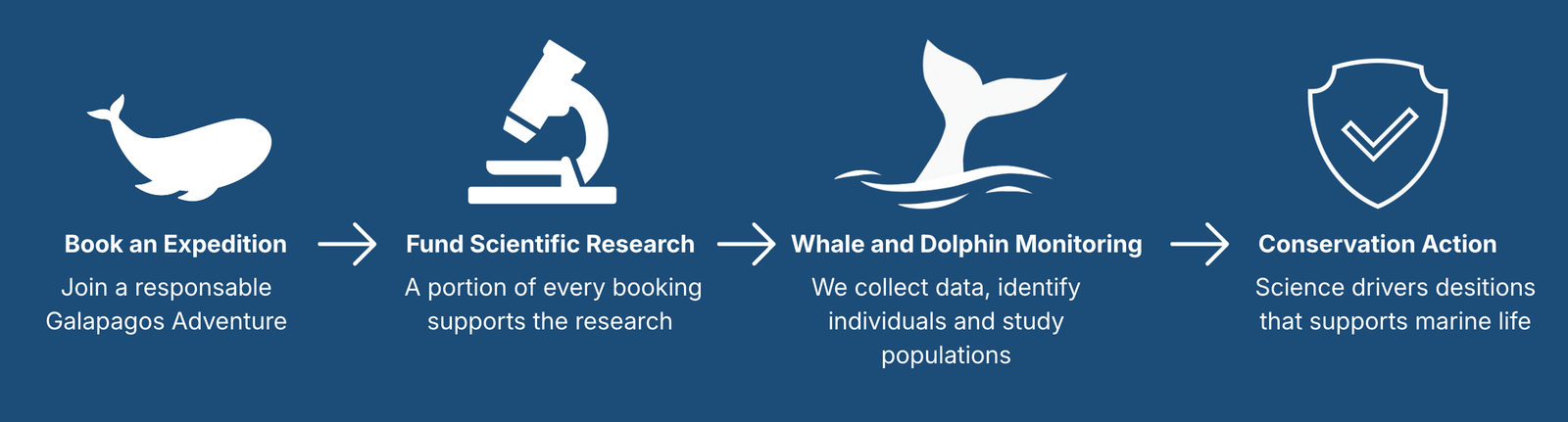
Researchers studying whales and dolphins in the Galápagos to support marine conservation.
galapagos wildlife support research conservation
Explore Galapagos
$1750
$450

Duration 4 Days
Difficulty Easy
Activity 7 Activities
Blue-footed booby with bright blue feet standing on volcanic rock in the Galápagos Islands
$287

Duration 8 Hours
Difficulty Easy
Activity 7 Activities
Los Túneles Isabela Tour with volcanic lava formations and Galápagos visitors
$230

Duration 8 Hours
Difficulty Easy
Activity 5 Activities
waved albatrosses on Española Island in the Galápagos
$230

Duration 8 Hours
Difficulty Easy
Activity 6 Activities
Galápagos shark swimming underwater among schools of striped fish
$197

Duration 10 Hours
Difficulty Easy
Activity 6 Activities

Ready to plan your Galápagos adventure?

Planning a Galápagos trip can feel overwhelming. We’re here to help you choose the right cruise or island-hopping experience based on your interests, travel style, dates, and budget.

Get In Touch

Start Planning Your Trip

Tell us about your travel plans, and we’ll create a personalized Galápagos itinerary tailored to your interests, travel dates, and budget.

Name
Please include: • Preferred travel dates • Number of travelers • Cruise or island hopping

Meet Your Galápagos Expert

icon address
Our Address

San Cristóbal
Galápagos,
Ecuador EC20035

phone
Phone Number

+593 986433143

For your curious mind