

By Africa Berdonces – Naturalist Guide & Founder of Nauti Expeditions
Growing up among giant tortoises.
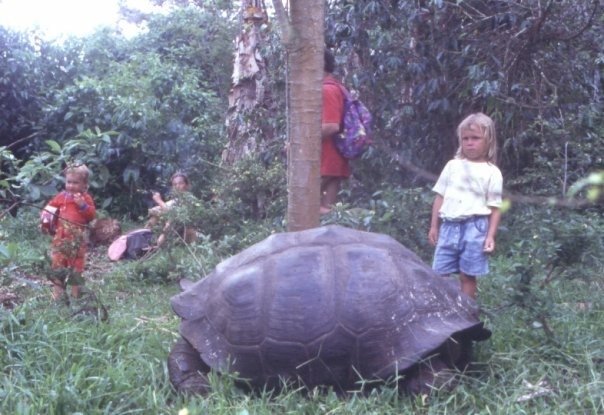
In the highlands of Santa Cruz, seeing giant tortoises was simply part of everyday life. They wandered through pastures, rested beside ponds, and occasionally appeared near our family farm. Finding one in the backyard was nothing unusual. In fact, many farms in the Galápagos highlands shared their land with these ancient giants.
As a child, I never thought much about it.
It wasn’t until I started guiding visitors that I realized how extraordinary these animals truly are. Travelers would cross oceans and spend years dreaming about seeing a giant tortoise in the wild. Yet for those of us raised in Galápagos, they were our neighbors.
Today, whenever I watch a visitor encounter their first giant tortoise, I see the same reaction: silence, awe, and a sense of stepping back in time. Standing just a few meters away from an animal that may be over a century old is a powerful reminder that Galápagos is unlike anywhere else on Earth.
The giant tortoise is more than the symbol of the Galápagos Islands. It is a living survivor of an ancient world, a key architect of island ecosystems, and one of the greatest conservation success stories ever told.
What Is a Galapagos Giant Tortoise?
Scientific Profile
| Category | Information |
|---|---|
| Common Name | Galapagos Giant Tortoise |
| Scientific Name | Chelonoidis spp. |
| Taxonomic Order | Testudines |
| Family | Testudinidae |
| IUCN Status | Varies by species (Vulnerable to Critically Endangered) |
| Endemic to Galapagos | Yes |
| Diet | Herbivore |
| Average Lifespan | 100–150+ years |
| Adult Weight | Up to 250 kg (550 lbs) |
| Adult Length | Up to 1.8 m (6 ft) |
| Active Season | Year-round |
| Best Time to Spot | Any month of the year |
| Main Islands | Santa Cruz, Isabela, Española, Pinzón, Santiago and others |
| Conservation Status | Protected through breeding and restoration programs |
| Ecological Role | Seed disperser and ecosystem engineer |
How Did Giant Tortoises Reach the Galápagos?
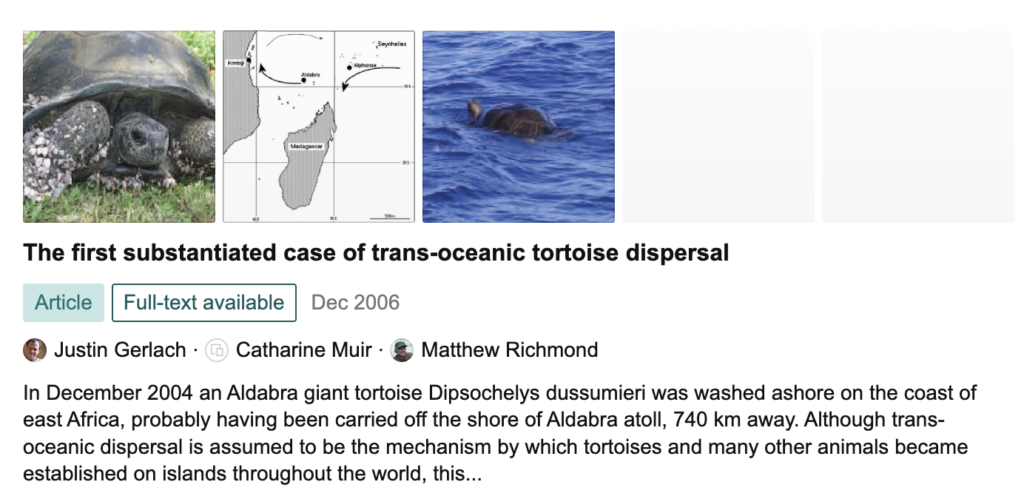
Standing beside a giant tortoise, it’s hard not to wonder how an animal weighing hundreds of kilograms ended up on remote volcanic islands nearly 1,000 kilometers (600 miles) from mainland South America.
After all, giant tortoises cannot swim long distances. They move slowly and spend their lives on land. Their presence in the Galápagos seems almost impossible.
Yet millions of years ago, the ancestors of today’s giant tortoises somehow completed one of the most extraordinary journeys in the natural world.
Scientists believe these ancient tortoises originated on the South American continent. Powerful floods may have swept vegetation, fallen trees, and small animals into rivers that eventually reached the Pacific Ocean. Carried westward by ocean currents, a few tortoises likely drifted across the sea on natural rafts of vegetation.
The journey would have been long and dangerous, but tortoises possess a remarkable advantage: they can survive for extended periods without food or fresh water. This unique ability may have allowed a handful of individuals to reach the young volcanic islands that would later become the Galápagos.
Those accidental pioneers changed the history of the islands forever.
Once isolated on different islands, tortoise populations evolved independently, giving rise to the incredible diversity of giant tortoise species that make the Galápagos famous today.
Evolution in Isolation: One Ancestor, Many Species
Arriving in the Galápagos was only the beginning of the story.
The first tortoises that reached the islands likely shared a common ancestor, but they soon encountered a landscape unlike anywhere else on Earth. The Galápagos archipelago was not a single island but a chain of volcanic islands separated by ocean channels, rugged terrain, and active volcanoes.
These natural barriers played a crucial role in evolution.
For a giant tortoise, even relatively short distances can become impassable when separated by lava fields, steep volcanic slopes, or stretches of ocean. As populations became isolated, they stopped exchanging genes with one another.
Imagine a group of tortoises living on one island becoming separated from another population by miles of ocean. Over thousands of generations, each group would face different environmental conditions, food sources, rainfall patterns, and landscapes. Without contact between populations, evolution began to take different paths.
Even within the same island, volcanic activity could create additional barriers. Vast lava flows and rugged terrain sometimes isolated tortoise populations for long periods, allowing them to evolve independently.
Over time, natural selection favored traits that helped tortoises survive in their local environments. On humid islands with abundant vegetation, tortoises evolved large dome-shaped shells. On drier islands, where food was often found higher above the ground, tortoises developed longer necks and the distinctive saddleback shell.
What began as a single ancestral population eventually gave rise to multiple species, each uniquely adapted to its island home.
The giant tortoises of Galápagos are therefore more than iconic wildlife. They are living evidence of how geography, isolation, and time can shape the course of evolution.
Why Do Galápagos Tortoises Look Different?
If all Galápagos giant tortoises share a common ancestor, why do some look so different from others?
The answer lies in the unique environments found across the archipelago.
As tortoise populations became isolated on different islands, natural selection favored traits that helped them survive local conditions. Over thousands of generations, these adaptations changed the shape of their shells, necks, and bodies.
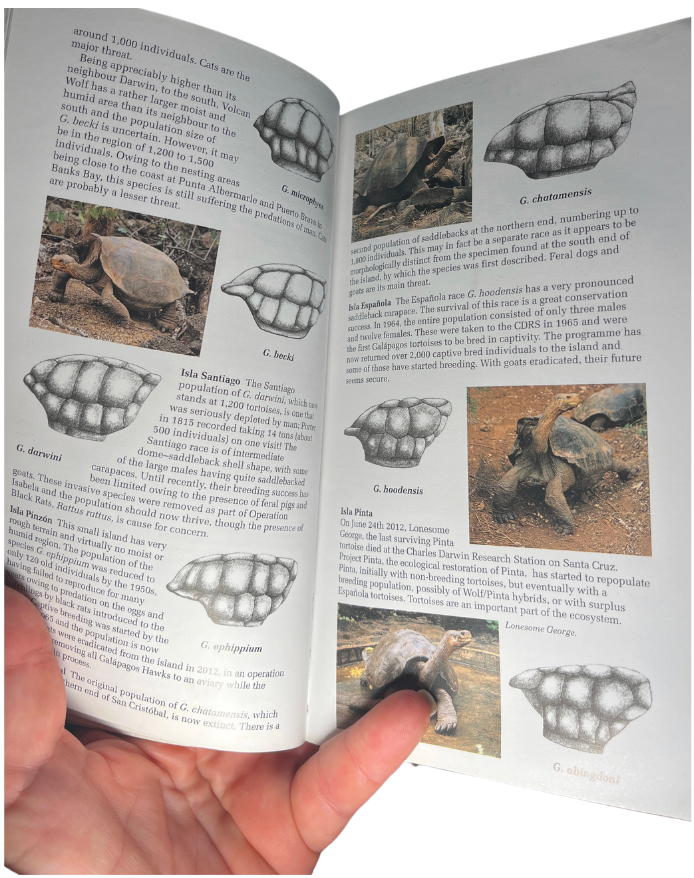
Naturalists generally recognize two main shell forms among Galápagos giant tortoises: dome-shaped and saddleback.
The dome-shaped tortoises are typically found on islands or in regions where vegetation is abundant and easily accessible. Their rounded shells and shorter necks are well suited to feeding on grasses and low-growing plants.
Saddleback tortoises, on the other hand, evolved in drier environments where food can be harder to reach. Their shells rise sharply above the neck, creating space for a longer upward stretch. Combined with longer necks and legs, this adaptation allows them to browse on cactus pads, shrubs, and vegetation growing higher above the ground.
These differences may seem subtle, but they tell a remarkable story. By simply looking at the shape of a tortoise’s shell, scientists can often identify the island where its ancestors evolved.
For Charles Darwin and later generations of scientists, these variations provided some of the clearest evidence that species can adapt over time to different environments.
In Galápagos, evolution is not just a theory discussed in textbooks. It is written on the shell of a giant tortoise.
Meet the Giants of Galápagos
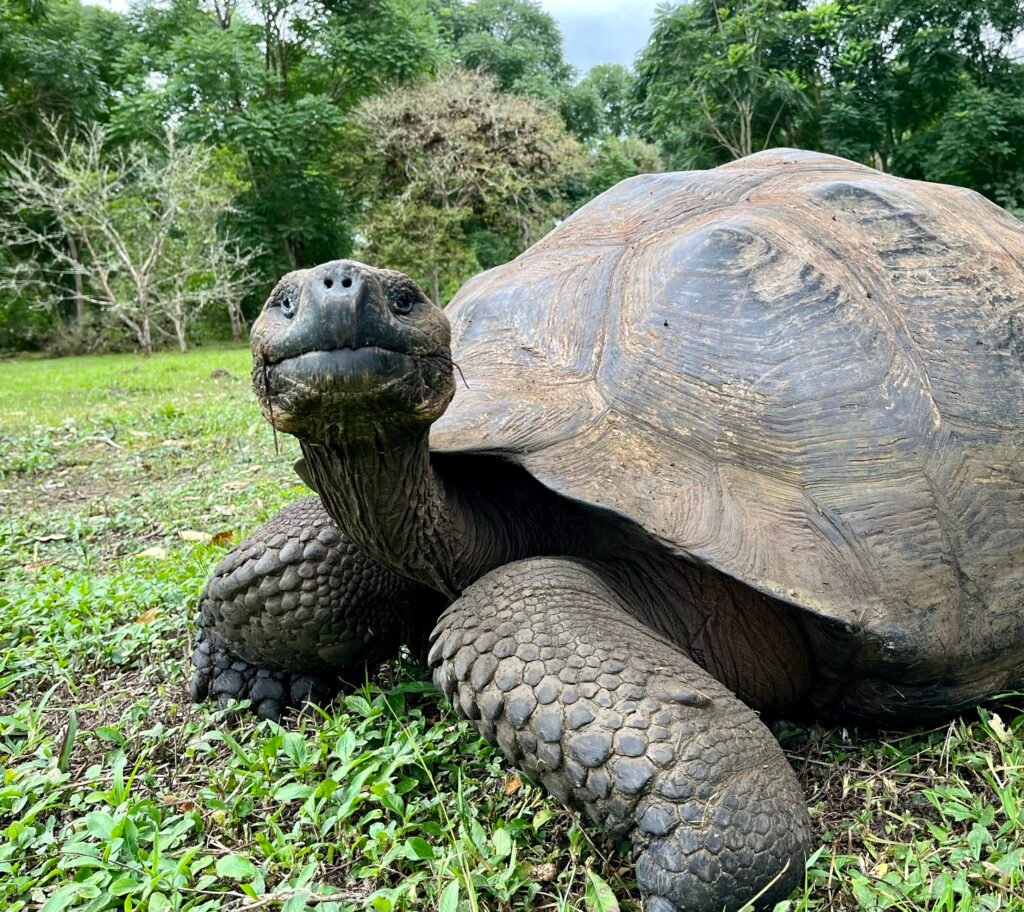
Today, scientists recognize several species of giant tortoises across the Galápagos Islands, each shaped by thousands of years of evolution in isolation.
While all Galápagos giant tortoises share a common ancestor, each species tells a different story. Some evolved on humid islands covered in lush vegetation, while others adapted to harsh, arid environments where food and water were scarce.
These differences can be seen in their shell shapes, body sizes, and even the landscapes they call home.
From the saddleback tortoises of Española and San Cristóbal to the massive dome-shaped tortoises of Santa Cruz and Isabela, each species represents a unique chapter in the evolutionary history of the Galápagos.
Although several populations came dangerously close to extinction, conservation efforts have helped many recover, allowing visitors today to observe these remarkable animals in both the wild and protected breeding centers.
Let’s take a closer look at the giant tortoises that continue to roam the Galápagos Islands today.
The Secret Life of a Giant Tortoise
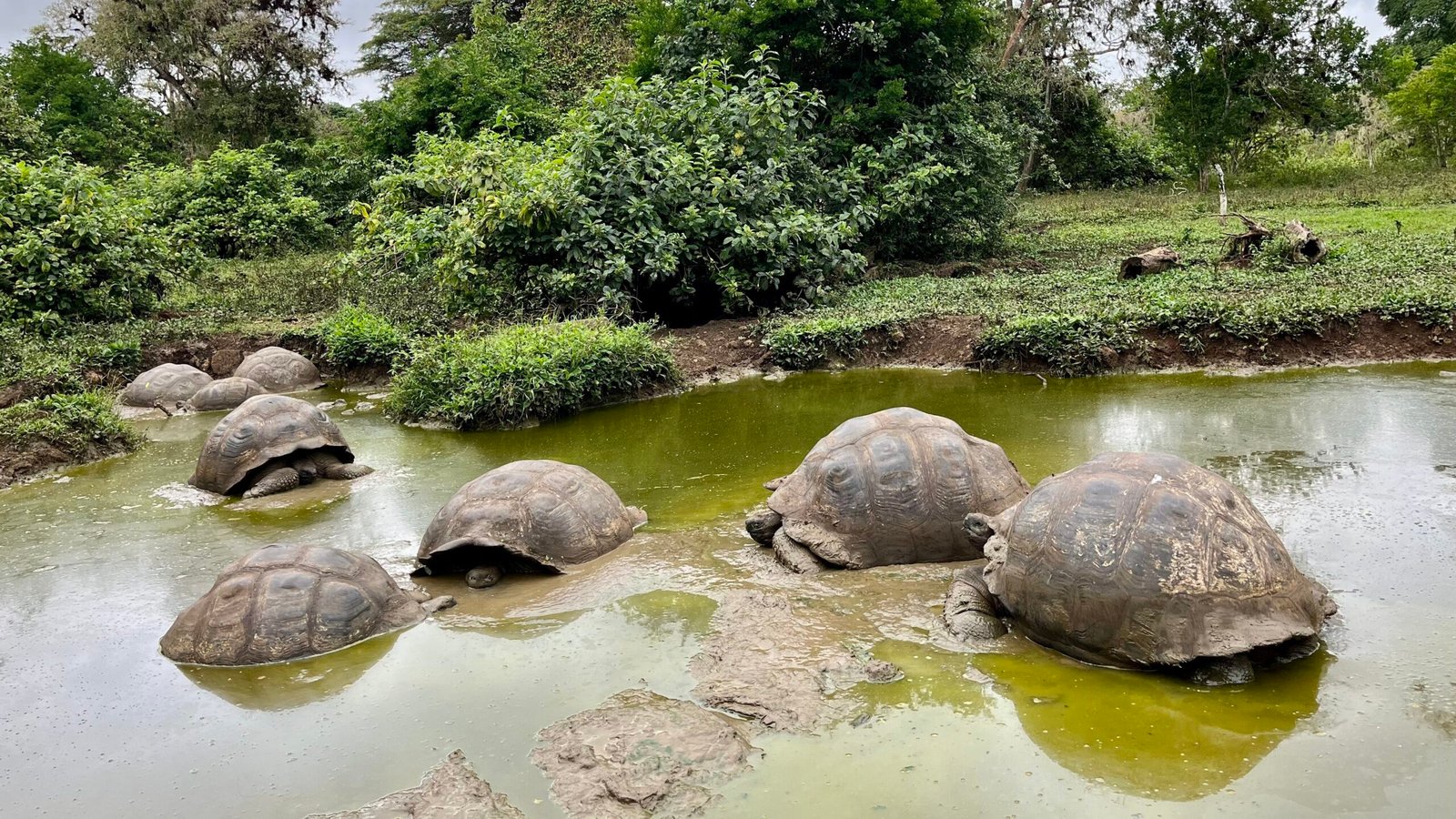
Despite their enormous size, giant tortoises live surprisingly quiet lives.
Most of their day is spent feeding, resting, and slowly moving through their habitat in search of food and water. During cooler hours, they graze on grasses, leaves, fruits, and cactus pads. As temperatures rise, they often retreat to the shade or rest in muddy pools that help regulate their body temperature.
Their slow movements have made giant tortoises famous, but don’t let their pace fool you. These animals are incredibly successful survivors.
Some individuals can live well over 100 years, making them among the longest-lived vertebrates on Earth. They can survive long periods without food or fresh water and have adapted to the challenging conditions of volcanic islands where resources are not always abundant.
One of the most fascinating behaviors observed in Galápagos is seasonal migration. In islands such as Santa Cruz, tortoises move between the humid highlands and lower elevations in search of food and suitable nesting areas. These journeys, repeated generation after generation, have shaped the ecology of the islands for thousands of years.
As they travel, tortoises disperse seeds in their droppings, helping plants colonize new areas. For this reason, scientists often refer to giant tortoises as ecosystem engineers—animals that help shape the environment around them.
In many ways, the Galápagos we know today would not exist without them.
From the Brink of Extinction to a Conservation Success Story
For millions of years, giant tortoises thrived across the Galápagos Islands with few natural threats.
That changed dramatically after humans arrived.
Beginning in the 17th century, pirates, whalers, and merchant ships discovered that giant tortoises could survive for months without food or water. Thousands were taken aboard vessels as a source of fresh meat during long ocean voyages.
Later, settlers introduced goats, pigs, rats, dogs, and cats to the islands. These animals destroyed habitat, consumed vegetation, and preyed on tortoise eggs and hatchlings. Some tortoise populations declined rapidly, while others disappeared entirely.
By the twentieth century, several species were on the verge of extinction.
Yet what followed became one of the world’s most remarkable conservation success stories.
Scientists, park rangers, and conservation organizations launched ambitious breeding and restoration programs to save the remaining tortoises. Eggs were protected, hatchlings were raised in captivity, invasive species were removed, and thousands of young tortoises were eventually returned to their native islands.
Today, many tortoise populations have recovered dramatically. Areas that once held only a handful of individuals are again home to thriving populations of these ancient giants.
Their recovery stands as a powerful reminder that conservation can work when science, commitment, and long-term vision come together.
Lonesome George: The Last of His Kind
No giant tortoise tells the story of conservation in Galápagos better than Lonesome George.
George was the last known Pinta Island giant tortoise, a species that once roamed Pinta Island in the northern Galápagos. By the time he was discovered in 1971, his population had already disappeared.
For decades, scientists searched for a mate that could preserve his lineage. Despite numerous efforts, George never produced offspring.
When he died on June 24, 2012, the world mourned not only the loss of an individual animal but the extinction of an entire species.
Yet George’s story did not end there.
His legacy brought international attention to conservation in Galápagos and inspired new efforts to protect endangered species across the archipelago. Today, genetic research has identified tortoises on Wolf Volcano carrying ancestry from the Pinta lineage, offering a small but exciting glimpse of hope for the future.
For many visitors, seeing George’s preserved body at the Charles Darwin Research Station is a powerful reminder that extinction is permanent.
His story teaches us that conservation is not only about protecting wildlife—it is about acting before it is too late.
A Future for the Giants
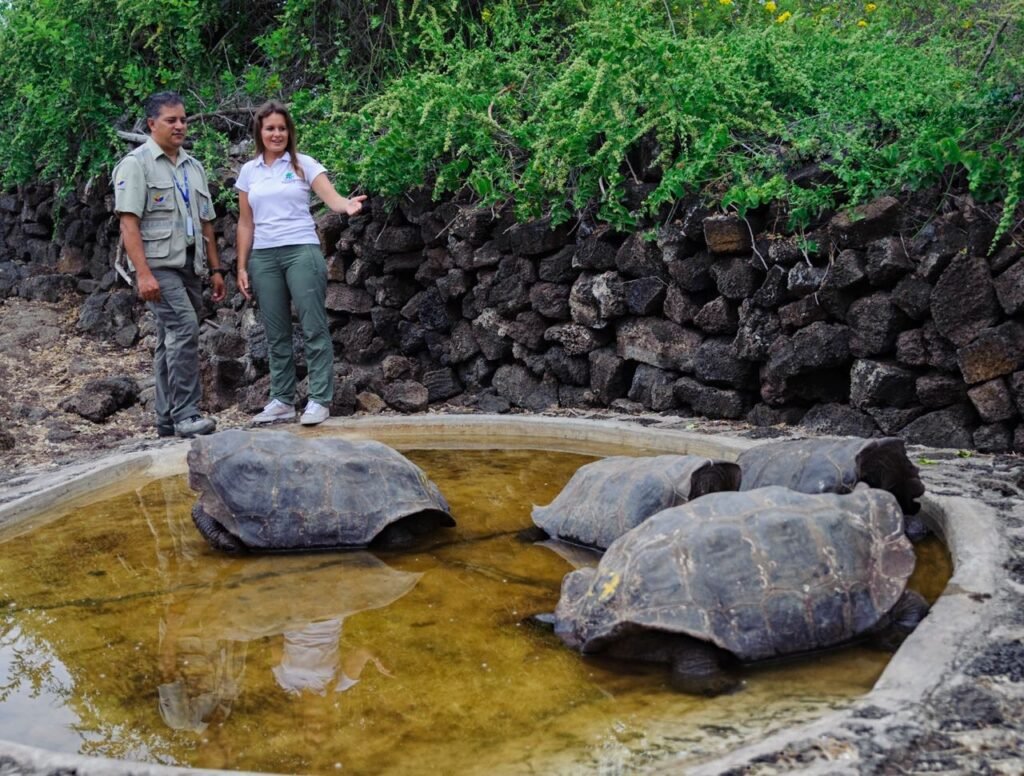
Fortunately, the story of Galápagos giant tortoises is not only a story of loss.
It is also a story of recovery.
Through decades of conservation efforts led by the Galápagos National Park Directorate, scientists, conservation organizations, and local communities, thousands of tortoises have been returned to islands where their populations once teetered on the edge of extinction.
Breeding centers have successfully raised and released young tortoises into the wild, invasive species have been removed from critical habitats, and nesting areas have been protected. As a result, several tortoise populations that were once critically endangered are now recovering.
Today, visitors to the Galápagos can witness one of conservation’s greatest success stories firsthand. Giant tortoises once again roam the highlands, cross ancient migration routes, and play their vital role in shaping island ecosystems.
Their future is not guaranteed, and conservation work continues every day. But compared to just a few decades ago, there is real reason for hope.
For those of us who call Galápagos home, seeing giant tortoises thrive once again is a reminder that protecting nature is not just about saving species. It is about preserving the extraordinary natural heritage that makes these islands unlike anywhere else on Earth.
Where Can You See Giant Tortoises in the Galápagos?
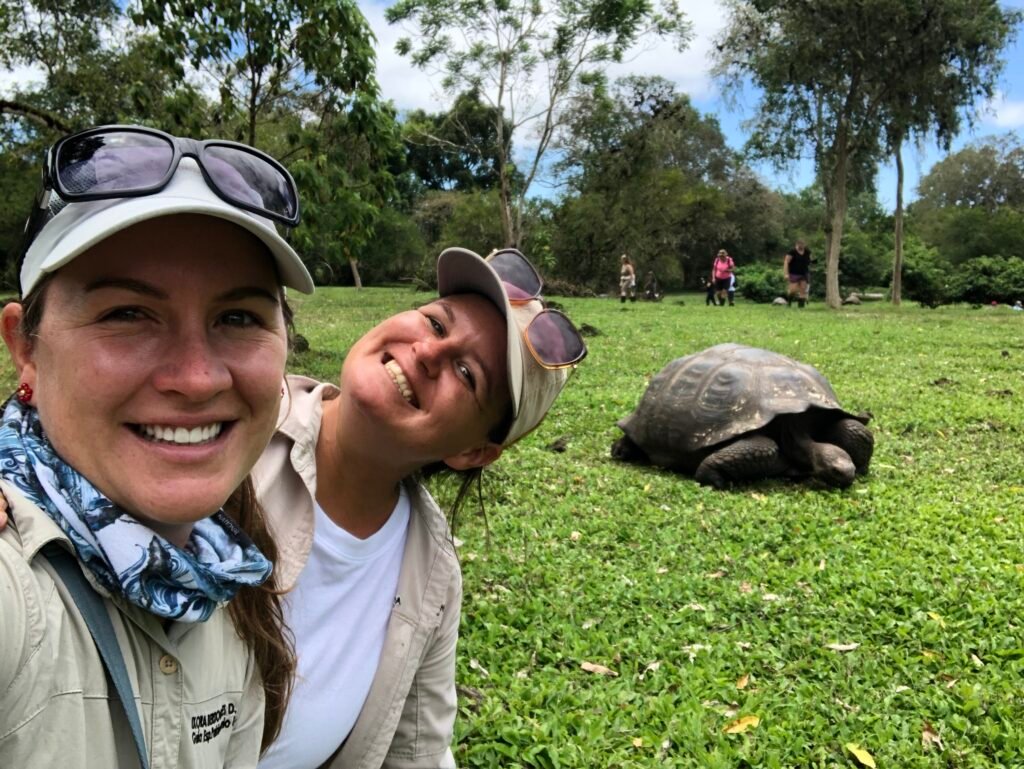
For many travelers, seeing a giant tortoise in the wild is one of the highlights of a Galápagos adventure.
The good news is that giant tortoises can still be observed on several islands, offering visitors a chance to experience these remarkable animals in the landscapes where they evolved.
Santa Cruz Highlands
One of the best places to see giant tortoises is in the highlands of Santa Cruz. Here, tortoises roam freely across farms, pastures, and natural reserves. During the cooler and wetter months, it is common to encounter them feeding, resting in muddy ponds, or slowly moving through the vegetation.
This is also where I grew up, and it remains one of my favorite places to observe tortoises in their natural habitat.
Rancho El Chato and Rancho Primicias
These private reserves provide excellent opportunities to see giant tortoises at close range while learning about their behavior, migration patterns, and ecological importance.
Many visitors are surprised by just how large these animals are when standing only a few meters away.
San Cristóbal Island
At Cerro Colorado, visitors can learn about conservation efforts and observe giant tortoises native to San Cristóbal. The site offers valuable insight into breeding and restoration programs that have helped protect these populations.
Isabela Island
Isabela is home to several giant tortoise populations and breeding centers. The island’s volcanic landscapes provide a fascinating backdrop for understanding how isolation contributed to the evolution of different tortoise species.
Charles Darwin Research Station
Located in Puerto Ayora, the Charles Darwin Research Station has played a critical role in tortoise conservation for decades. It is also where many visitors learn the story of Lonesome George and the efforts that continue to protect Galápagos wildlife today.
Wherever you encounter them, seeing a giant tortoise in the Galápagos is far more than a wildlife sighting. It is an opportunity to connect with millions of years of evolutionary history and one of the most extraordinary conservation stories on Earth.
Final Thoughts from a Naturalist Guide
I grew up among giant tortoises.
As a child in the highlands of Santa Cruz, seeing these animals was simply part of everyday life. They wandered through pastures, rested near ponds, and occasionally appeared just outside our home. Like many people raised in Galápagos, I never imagined that travelers from around the world dreamed of seeing what I considered normal.
Years later, after guiding visitors throughout the islands, I understand why.
There is something profoundly moving about standing beside a giant tortoise. Perhaps it is knowing that the animal before you may have been alive for more than a century. Perhaps it is the realization that you are looking at a living descendant of the same tortoises that helped inspire our understanding of evolution.
Or perhaps it is simply the reminder that places like Galápagos still exist.
In a rapidly changing world, giant tortoises teach us patience, resilience, and the importance of protecting the natural wonders that connect us to our planet’s past.
If you are planning a visit to the Galápagos Islands, I hope you have the opportunity to experience that feeling for yourself.
And when you finally stand face to face with a giant tortoise in the wild, you may understand why these gentle giants have captured the imagination of travelers, scientists, and conservationists for generations.
After all, the story of the giant tortoise is not just the story of a species.
It is the story of Galápagos itself.
Frequently Asked Questions
How many species of Galápagos giant tortoise are there today?
This is a genuinely evolving scientific question rather than a fixed number. Traditionally, taxonomists described around 14 to 15 subspecies of Galápagos giant tortoise, several of which are now extinct — including the Pinta Island lineage, whose last known individual, Lonesome George, died in 2012. In 2021, an IUCN working group briefly proposed classifying all living populations as a single species. Since then, whole-genome genetic analysis has overturned that view: a more recent study identified 13 genetically distinct living lineages, now increasingly treated as full species rather than subspecies of one another. In short — the honest, current answer is 13 distinct living lineages, with the classification still actively being refined as genetic research improves.
How old can Galápagos tortoises live to be?
Galápagos giant tortoises are among the longest-lived vertebrates on Earth, with wild individuals commonly estimated to live 100 to 150 years, and some captive individuals documented living well beyond that — a slow metabolism, minimal predation pressure in their native island environment, and gradual growth throughout life all contribute to this exceptional lifespan. Age is difficult to determine precisely in wild individuals without long-term tracking, since tortoises don’t show obvious external aging markers the way many mammals do, which is part of why some age estimates for older captive tortoises remain debated.
What happened to Lonesome George?
Lonesome George was the last known individual of the Pinta Island tortoise lineage, discovered alone on Pinta Island in 1971 after the population had been devastated by historical hunting and introduced goats that destroyed native vegetation. Decades of conservation efforts, including attempts to breed him with genetically similar tortoises from other islands, failed to produce viable offspring, and he died on June 24, 2012, of natural causes, becoming an internationally recognized symbol of extinction and Galápagos conservation. His preserved body is now displayed at the Charles Darwin Research Station on Santa Cruz. Since his death, genetic research has identified tortoises on Wolf Volcano (Isabela Island) carrying partial Pinta ancestry, likely descended from tortoises relocated by whalers generations ago — a discovery that has renewed interest in eventually restoring a Pinta-like lineage.
Where can I see giant tortoises in the wild versus at a breeding center?
Both experiences are available and genuinely different. The Santa Cruz highlands — including reserves like Rancho El Chato and Rancho Primicias — let you see tortoises roaming completely wild, in their natural habitat, at no additional cost beyond transportation and guide fees. The Charles Darwin Research Station, also on Santa Cruz, is a breeding and conservation center where you can see tortoises up close in managed enclosures, alongside exhibits explaining the conservation program’s history — including Lonesome George’s story. Most of our multi-day itineraries include both, since they answer different questions: one shows you the animal as it actually lives, the other explains how close the species came to losing entire lineages, and what’s being done about it.


Our Address
San Cristóbal
Galápagos,
Ecuador EC20035

Phone Number

Email Address
Blue-Footed Boobies: Mating Dance, Facts & Where to See Them
Meet the Blue-Footed Booby Few animals represent the Galápagos Islands as perfectly as the Blue-footed Booby. With their bright turquoise feet, comical personalities, and
Understanding Galápagos Ocean Currents and Their Impact on Wildlife
Why is the Galápagos home to such extraordinary wildlife? The answer lies beneath the surface. Four major ocean currents converge around the archipelago, bringing nutrients,
Do Blue Whales From Two Different Hemispheres Meet in the Galápagos?
GALAPAGOS BLUE WHALES The blue whale is the largest animal known to have ever existed on Earth — larger than any dinosaur, its heart alone