
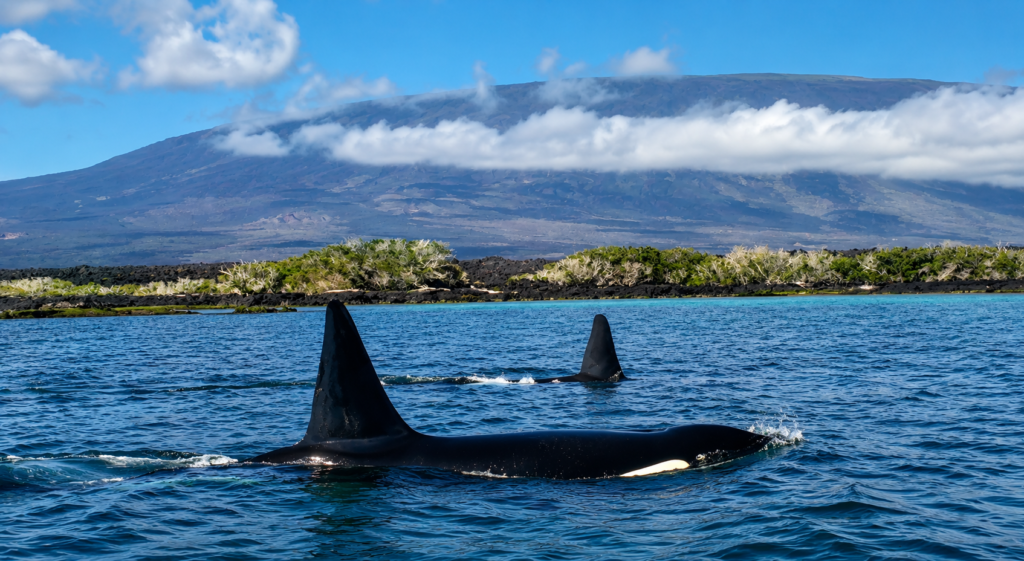
Ask most people whether killer whales have families, and they’ll say yes without hesitating — probably picturing a devoted matriarch leading her pod through cold, grey water, her children and grandchildren never straying far for their entire lives. It’s a beautiful image, and for one of the best-studied orca populations on Earth, it’s also true.
But sail two thousand miles south to the Galápagos Islands, sitting almost exactly on the equator, and that tidy picture starts to come apart. Here, researchers spent 26 years photographing the same killer whales, in the same way that a family might quietly build a photo album — and what they found was a society that behaves less like a fixed family tree and more like a network of friendships that expand, contract, and reshape themselves depending on the day.
This is the story of what that photo album revealed.
The family model everyone already knows
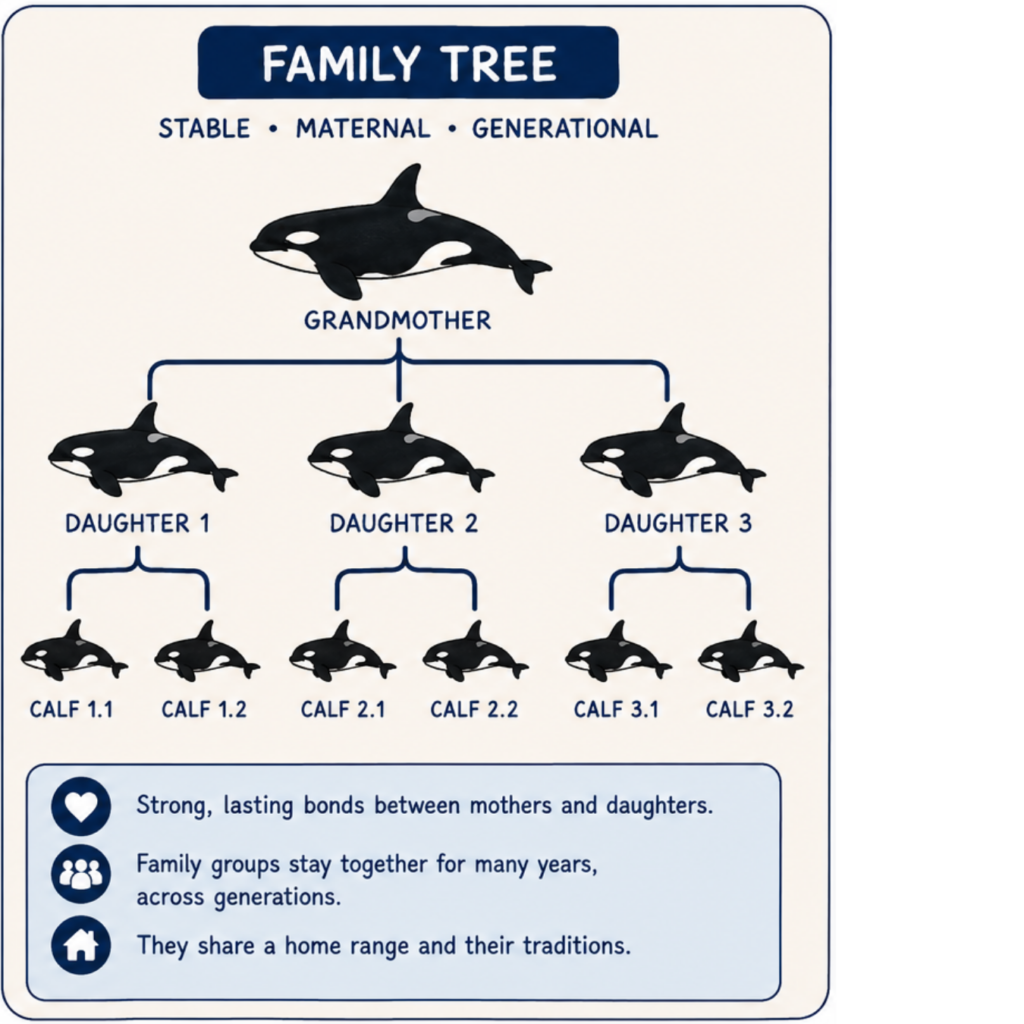
Most of what the world knows about killer whale society comes from the cold, food-rich waters of British Columbia and Alaska, where researchers have followed identifiable individuals for decades. There, killer whales live in matrilines — a term that simply means a family organized around the mother’s line, the way a family tree is organized around a grandmother, her children, and her children’s children.
In these populations, offspring of both sexes often stay with their mother for life. Sons in particular tend to remain tightly bonded to her — some of the strongest relationships ever recorded in killer whales are between an adult male and his mother. The result is a stable, permanent pod: the same individuals, traveling together, year after year, decade after decade.
It’s a genuinely remarkable social system. It’s also, as it turns out, not the only way to be a killer whale.
A 26-year question at the equator
The Galápagos Marine Reserve is one of the most productive stretches of ocean on the planet, but it is productive in a very different way than the cold coastlines of the Pacific Northwest. Instead of a stable, cold, food-rich environment year-round, Galápagos waters are shaped by shifting currents, seasonal upwelling, and the irregular rhythm of El Niño and La Niña events — some years abundant, some years lean.
Killer whales are among the most frequently sighted cetaceans in the archipelago, present year-round in nearshore waters. But almost nothing was known about how they organized themselves socially — whether they lived in the same kind of tight, permanent matrilines seen elsewhere, or something else entirely.
Answering that question meant doing something deceptively simple: getting to know individual whales well enough, over enough years, to see who spent time with whom.
How do you get to know a whale you can never tag?
You can’t interview a killer whale, and in a place like Galápagos — remote, difficult to access with heavy research equipment, and strictly protected — satellite tags and long-term captures were never realistic tools. Instead, researchers used something every visitor to the islands already carries: a camera.
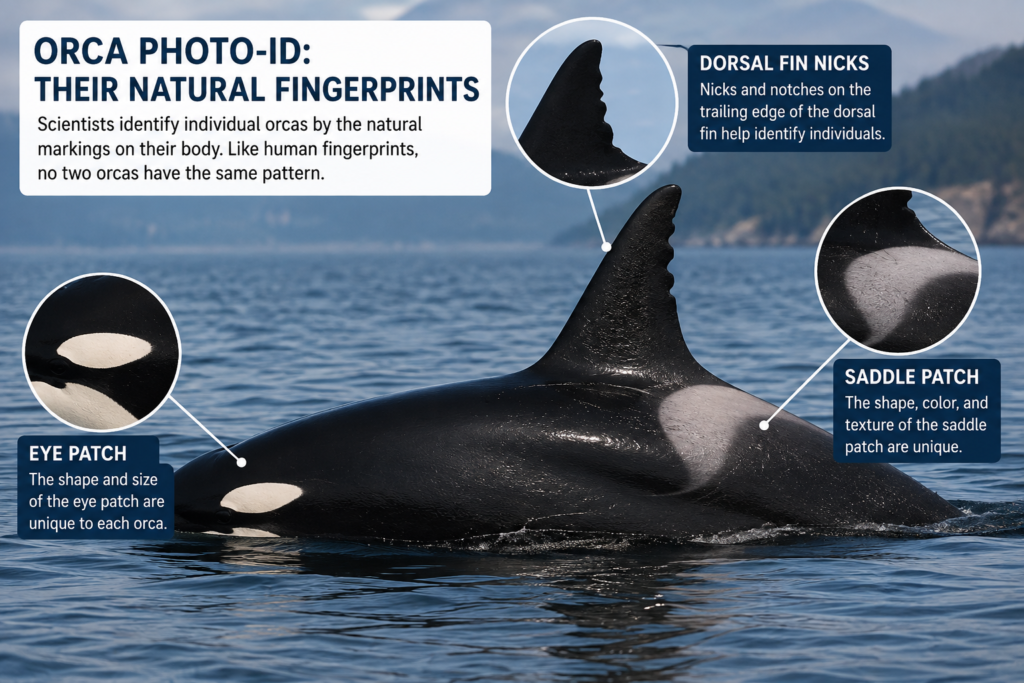
Every killer whale’s dorsal fin is slightly different — nicked, notched, or curved in its own particular way, much like a human face. Just behind that fin sits a pale grey “saddle patch,” and above the eye, a white “eye patch,” both of which vary subtly enough from animal to animal to work like a natural fingerprint.
Between 1991 and 2017, researchers and their collaborators gathered photographs during 91 separate encounters with killer whales in Galápagos waters — 627 usable images in total. By carefully comparing fin shape, saddle patch, and eye patch across photos, they were able to recognize 64 individual whales, some of them showing up again and again over more than two decades.
Eighteen of those whales turned up so consistently — in at least three separate years each — that researchers began to think of them as “local” residents of the archipelago, distinct from a much larger, more transient population of 46 “non-local” whales passing through less often.
A family that keeps rearranging itself
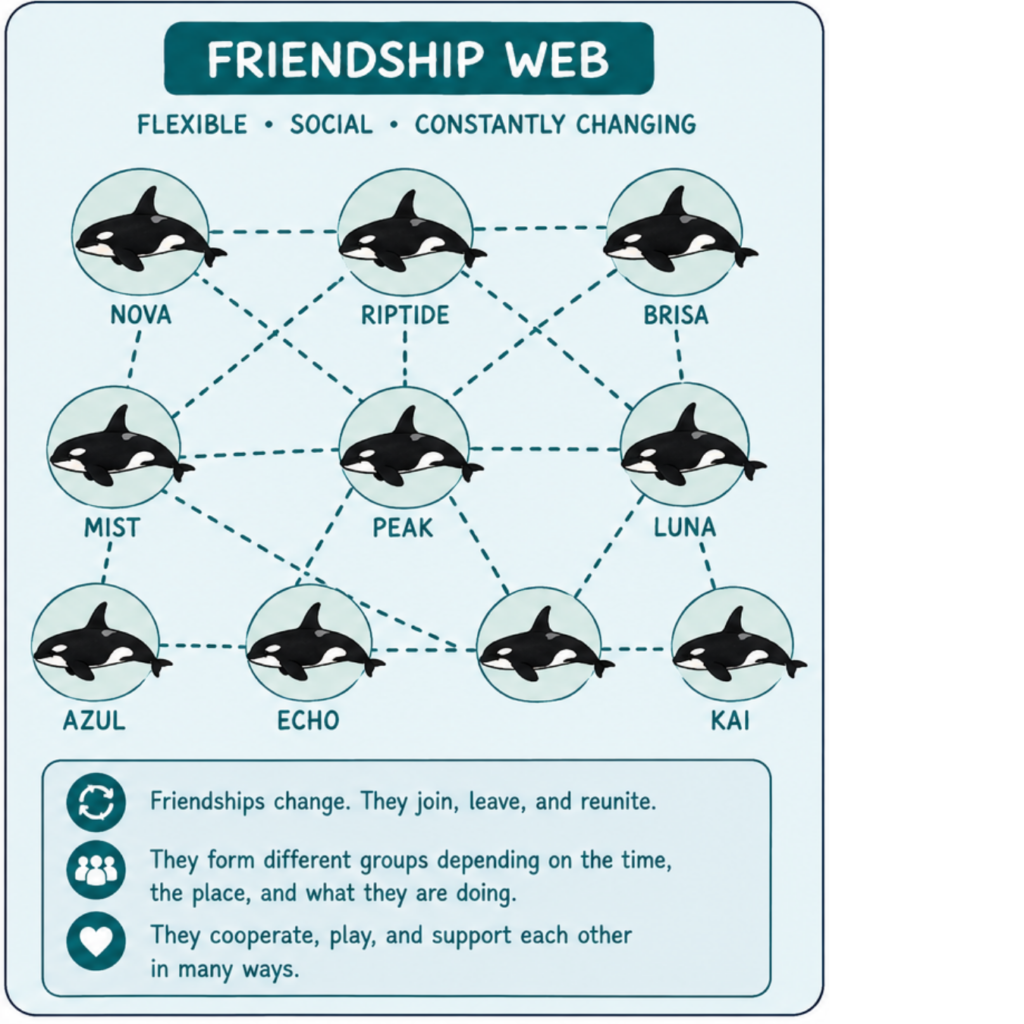
Here is where the story diverges from the Pacific Northwest script. When researchers mapped out how often each of the 18 resident whales appeared together, they didn’t find one stable pod, or even a handful of stable pods behaving like the tight, permanent family units seen in colder waters.
Instead, they found three distinct social units, plus one looser association of six whales that moved between groupings more freely — and, crucially, individuals from these different units regularly mixed and reshuffled. Groups themselves tended to be small: across 221 total sightings, pairs and trios were the most common configuration, and 69% of all groups contained four animals or fewer. The single largest group ever recorded numbered 15.
Scientists have a name for this kind of society: fission-fusion. It describes a group that splits (“fission”) into small units for day-to-day life, then merges (“fusion”) into larger gatherings when circumstances call for it — the same basic pattern seen in African elephant herds and in bottlenose dolphin communities. Rather than one extended family traveling together permanently, imagine a wide social network — more like an extended family that meets up for holidays and splits into smaller households the rest of the year.
The finding nobody expected: the strongest bond was between two males
If there’s one detail from this research that upends the popular image of orca family life, it’s this: the single strongest, most consistent bond recorded in the entire 26-year study wasn’t between a mother and calf, or between siblings. It was between two adult males.
In the well-studied populations of the Pacific Northwest, the tightest relationships are almost always between a mother and her adult son. Male-male friendships, when they occur at all, tend to be looser. In the Galápagos data, the opposite pattern emerged: strong, long-lasting bonds between males were common, and the strongest association in the whole dataset — persisting for several years — belonged to a pair of adult males.
It’s a small detail with a big implication. Of the 18 resident whales tracked, seven — 38% — were identifiable adult males, a notably higher proportion than reported in well-studied populations off British Columbia (25–28%). Male killer whale friendships, at least here, appear to be doing real social work.
Why would a family need to be this flexible?
Fission-fusion societies aren’t random — they tend to evolve where flexibility pays off. Researchers point to two features of Galápagos life that may explain why local orcas organize themselves this way.
The first is food. Killer whales here are opportunistic generalists, feeding on fish, sharks, sea turtles, sea lions — and, remarkably, other whales. Cooperative attacks on Bryde’s whales and sperm whales have been directly documented in Galápagos waters, and these hunts require far more animals than a typical two- or three-whale group can muster. When a hunting opportunity of that scale appears, several small units appear to fuse temporarily into a larger hunting party, then disperse again once the opportunity has passed.
The second is the ocean itself. Unlike the reliably rich, cold waters that support large, permanent pods elsewhere, productivity around the equator swings dramatically with the seasons and with El Niño cycles. A social structure that can expand and contract on demand may simply be a better fit for an environment that never stays the same for long.
From a guide’s camera to a scientific dataset
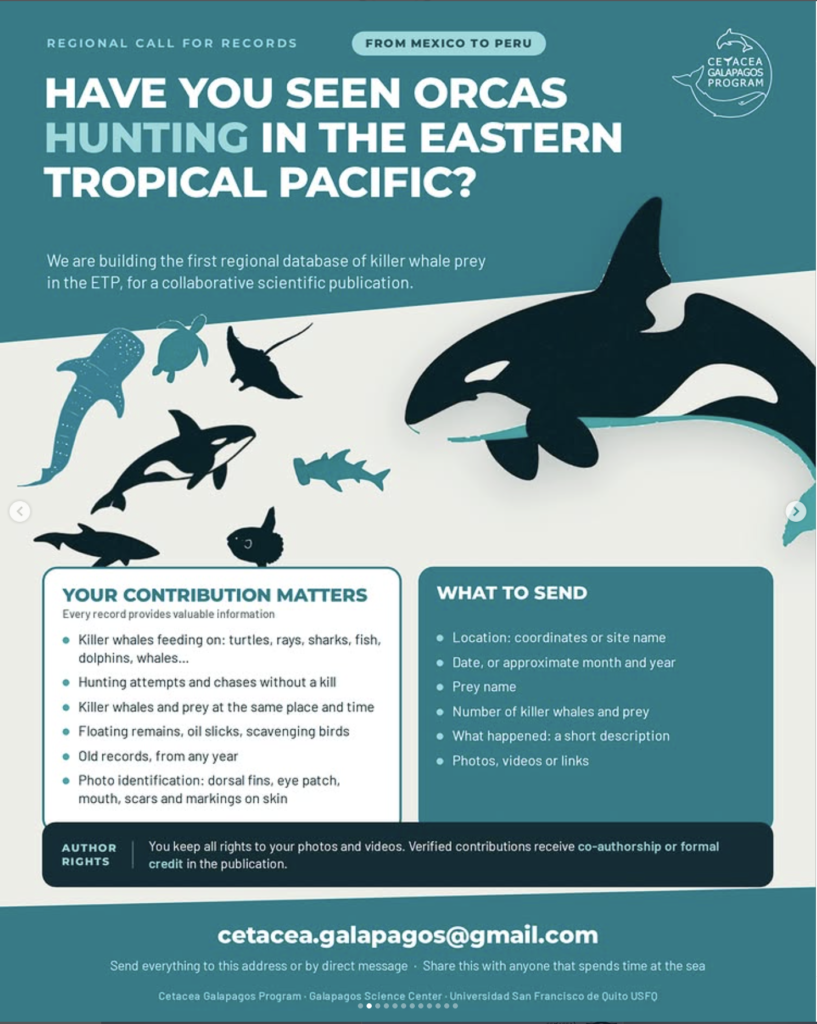
None of this research came from a dedicated fleet of research vessels bristling with equipment. It came, overwhelmingly, from expedition ships already sailing these waters for entirely different reasons — carrying naturalist guides and travelers who happened to have a camera in hand when a dorsal fin broke the surface.
Photographs contributed by guides aboard long-running Galápagos expedition vessels, gathered patiently across decades, form the backbone of the entire 26-year dataset. A single well-focused photograph of a dorsal fin, taken by someone simply excited to see a killer whale, can become a genuine data point the moment it’s compared against the growing photo-identification catalogue.
This is citizen science in its truest form: not a separate activity bolted onto a vacation, but the natural byproduct of paying close attention to a wild ocean.
What we still don’t know
Good science is honest about its blind spots, and this study is no exception. Because the observations were gathered opportunistically — whenever whales happened to be encountered — rather than through a systematic, year-round tracking program, researchers can describe patterns of association with confidence, but can’t yet say for certain whether these social units are built on genetic family ties the way Pacific Northwest matrilines are.
No genetic sampling has yet confirmed how the Galápagos “units” are related to one another. It also isn’t yet known whether Galápagos killer whales represent a genetically distinct population from other Eastern Tropical Pacific orcas, how long individual calves survive, or exactly how stable these social units remain across an animal’s full lifetime. Each of these questions represents a live, ongoing research priority — and each depends on the same tool that built this dataset in the first place: more photographs, gathered over more years, by more people willing to look closely.
Why this matters beyond curiosity
Understanding social structure isn’t just a pleasant biological detail — it shapes how a species can be protected. A population organized around tight, permanent family units can be devastated by the loss of a single individual in a way a more loosely connected population might not be. Knowing whether Galápagos orcas depend on specific long-term partnerships — like that unusually strong male-male bond — helps researchers understand what, exactly, would be lost if one of these animals disappeared.
It’s also a reminder of how much remains genuinely unknown about even a species as famous and well-studied as the killer whale. The version of orca society most people have absorbed from documentaries is real — but it is only one dialect in a much larger, still unfolding conversation about how these animals live.
Experience It in the Galápagos
There is a particular kind of stillness that settles over a boat when a tall, black dorsal fin rises out of the water nearby — the collective, unspoken agreement to stop talking and simply watch. What this research adds to that moment isn’t a fact to recite; it’s a different way of seeing.
A pair of orcas surfacing side by side, in step with one another, might not be a mother and calf at all. It might be two old friends — a bond that has already outlasted the memory of every guide currently aboard the ship, one thread in a much larger social fabric that has been quietly observed, one photograph at a time, since long before anyone reading this had ever heard of the Galápagos.
Traveling with people who understand that context doesn’t change what a guest sees through their binoculars. It changes what they understand about it — and that, more than anything, is the difference between watching wildlife and beginning to know it.
Frequently Asked Questions
Do killer whales live in family groups? Some populations do, in a very literal sense — offspring staying with their mother for life. Galápagos killer whales show a looser, more flexible social system where small groups regularly reshuffle, though long-term bonds, including between males, still last for years.
What is a “pod,” and do Galápagos orcas have one? “Pod” usually describes a stable, long-term family group. Galápagos killer whales don’t fit that model neatly — researchers instead describe three distinct social “units” plus a looser association among the archipelago’s long-term resident whales, with individuals moving between them.
How are individual killer whales identified in photographs? By the shape of the dorsal fin (including nicks and notches), the pattern of the grey “saddle patch” behind it, and the white “eye patch” — natural markings unique enough to function like a fingerprint.
Are Galápagos killer whales the same as the orcas from Pacific Northwest documentaries? They’re the same species, but a different population with a different social structure. Pacific Northwest resident and transient killer whales form stable, permanent matrilines; the Galápagos population studied so far shows a more fluid, fission-fusion pattern.
Do baby orcas stay with their mothers? Calves were most often seen in groups of three or more animals rather than alone with their mother — simple mother-calf pairs made up only about 11% of recorded sightings, suggesting Galápagos calves are usually surrounded by additional adults.
Why do killer whales form such strong bonds between males? It’s not fully understood, but the pattern is striking: the strongest, longest-lasting bond recorded in the Galápagos study was between two adult males — the opposite of what’s typically seen in colder-water populations, where mother-son bonds are usually strongest.
What is a fission-fusion society? A social system where small groups split apart for day-to-day life and merge into larger gatherings when conditions call for it — the same basic pattern seen in African elephants and bottlenose dolphins.
How long do killer whale relationships last? In the Galápagos dataset, associations between resident individuals lasted several years on average, and some individuals were recognized across more than two decades of sightings.
Do orcas in Galápagos hunt in groups? Yes. Cooperative hunting on very large prey — including Bryde’s whales and sperm whales — has been directly documented, typically involving several smaller units temporarily joining forces.
Are Galápagos killer whales endangered? The species overall is listed by the IUCN as Data Deficient rather than assigned a specific threat category, largely because so many distinct populations exist worldwide. The conservation status of the Galápagos population specifically has not yet been separately assessed.
Can tourists help killer whale research? Yes — much of the foundational data on Galápagos killer whale social structure came directly from photographs taken by naturalist guides and travelers aboard expedition vessels over more than two decades.
Are killer whales dangerous to swimmers or divers? There are no documented attacks on humans by wild killer whales anywhere in the world, including the Galápagos. They are formidable predators of other marine species but are not known to target people.
References
Denkinger, J., Alarcón, D., Espinosa, B., Fowler, L., Manning, C., Oña, J., & Palacios, D. M. (2020). Social structure of killer whales (Orcinus orca) in a variable low-latitude environment, the Galápagos Archipelago. Marine Mammal Science. https://doi.org/10.1111/mms.12672
Baird, R. W., & Whitehead, H. (2000). Social organization of mammal-eating killer whales: Group stability and dispersal patterns. Canadian Journal of Zoology, 78, 2096–2105.
Bigg, M. A., Olesiuk, P. F., & Ellis, G. M. (1990). Social organization and genealogy of resident killer whales (Orcinus orca) in the coastal waters of British Columbia and Washington State. Reports of the International Whaling Commission, Special Issue 12, 383–405.
Alava, J. J., Smith, K. J., Hernandez, J. O., Alarcón, D., Merlen, G., & Denkinger, J. (2013). Observations of killer whale (Orcinus orca) attacks on Bryde’s whales (Balaenoptera edeni) in the Galápagos Islands. Aquatic Mammals, 39, 196–201.
Wittemyer, G., Douglas-Hamilton, I., & Getz, W. (2005). The socioecology of elephants: Analysis of the processes creating multitiered social structures. Animal Behaviour, 69, 1357–1371.
IUCN Red List. Orcinus orca assessment (Data Deficient). Retrieved via iucnredlist.org.
Note: This article draws on the peer-reviewed methodology and findings of Denkinger et al. (2020) and does not duplicate the Cetacea Galápagos Program’s own scientific species page — it translates the published research into an educational narrative for a general travel audience. Readers seeking the full technical species profile should be directed to the Cetacea Galápagos Program’s Killer Whale page.